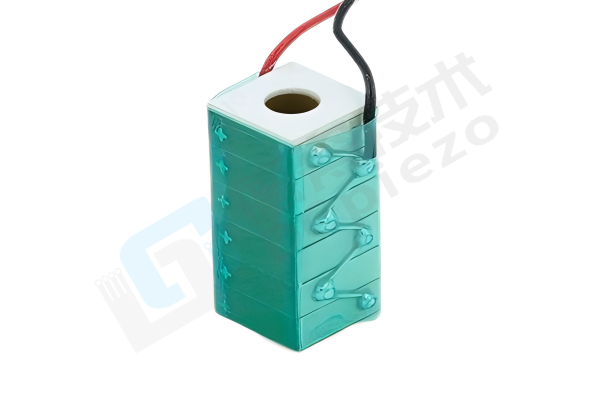
Energy management is moving from "centralized power supply and passive consumption" to "distributed harvesting and active optimization." In this transformation, a frequently overlooked yet highly promising technological fulcrum is emerging – multilayer stack piezoelectric ceramics. They are not only star materials in the field of precision actuation, but also intelligent transduction elements capable of converting wasted mechanical vibrations in the environment into usable electrical energy. As wireless sensor networks, industrial IoT, and smart infrastructure increasingly demand "maintenance-free power supply," multilayer stack piezoelectric ceramics are opening a new technological pathway for energy management with their unique energy harvesting capabilities.
I. The Overlooked Energy Source: The "Invisible Electricity" Hidden in Vibration
Industrial equipment operation, rail transit movement, bridges trembling in the wind, daily human activity – these scenarios contain abundant low-frequency, broadband mechanical vibration energy. In the past, most of this energy was dissipated as heat and noise, rarely utilized effectively. Piezoelectric energy harvesting technology has changed this situation. Based on the direct piezoelectric effect, piezoelectric ceramics generate surface charges when subjected to mechanical stress, and stable electrical output can be obtained through circuit conditioning. The significance of the multilayer stack structure lies in its integration of multiple piezoelectric units in a mechanically series, electrically parallel configuration, greatly enhancing charge output capability within a limited volume, enabling a single device to drive low-power sensors or wireless transmission modules. This means a wireless temperature sensor that originally required regular battery replacement can operate continuously for years relying on the equipment's own vibrations; a bridge health monitoring node can obtain power from minute deformations caused by passing vehicles, completely eliminating wiring constraints.
II. Self-Powered Sensor Networks: Making IoT Truly "Wireless"
The bottleneck of industrial IoT often lies not in communication technology, but in power supply. If thousands of sensors distributed inside equipment, along pipelines, and deep within structures all relied on batteries, maintenance costs would rise exponentially. Multilayer stack piezoelectric ceramics provide an elegant solution to this challenge:
●Maintenance-Free Operation: Piezoelectric harvesting modules convert ambient vibrations into electrical energy. Combined with power management circuits and supercapacitors, they form microwatt-to-milliwatt self-powered systems that support periodic sensor acquisition and wireless transmission.
●Extreme Environment Adaptability: Piezoelectric ceramics contain no electrolytes and no moving parts, remaining stable under high temperature, high humidity, and strong electromagnetic interference – far superior to traditional battery solutions.
●Integration with Sensing Functions: The same piezoelectric element can both harvest vibration energy and sense equipment status, achieving "one material, two functions" and simplifying system architecture.
In scenarios such as rotating machinery monitoring, oil and gas pipeline inspection, and underground utility tunnel surveillance, this self-powered solution is moving from concept to large-scale deployment.
III. Industrial Energy Efficiency Optimization: From "Energy-Consuming Component" to "Energy Recovery Node"
In traditional perception, actuators are merely terminals that consume energy. However, the inverse and direct piezoelectric effects of multilayer stack piezoelectric ceramics can work bidirectionally, enabling them to recover partial energy under certain operating conditions and improve overall system energy efficiency. For example, in high-frequency reciprocating motions such as precision stamping, ultrasonic machining, and vibratory feeding, piezoelectric actuators can convert part of the mechanical energy into electrical energy during the return or damping phase and feed it back to the drive circuit. Although the energy recovered per cycle is limited, under high-frequency continuous operation, the cumulative energy-saving effect is considerable. More importantly, this energy recovery capability gives piezoelectric drive systems an added value in energy management dimensions that traditional electromagnetic solutions find difficult to match. In addition, precision valves, micro-pumps, and other actuation elements driven by piezoelectric ceramics are themselves known for low power consumption and high response, and are replacing traditional high-energy-consuming actuators in industries with extremely high energy consumption and cleanliness requirements, such as semiconductors, biomedicine, and precision chemicals, reducing system operating costs from the source.
IV. Smart Infrastructure: Enabling Buildings and Transportation to "Sense Their Own Energy Consumption"
In the fields of smart buildings and smart transportation, energy management is not only about power supply, but also about precise perception and dynamic optimization of energy consumption behavior.
Multilayer stack piezoelectric ceramics can be embedded in structural nodes such as building curtain walls, bridge bearings, and rail fasteners. On one hand, they harvest energy generated by wind-induced vibration and traffic loads to power monitoring systems; on the other hand, they analyze vibration signals to determine structural status and load changes. When this data flows into an energy management platform, dynamic adjustments can be made to air conditioning, lighting, elevator systems, and more – for example, automatically adjusting regional air supply based on crowd vibration intensity, or optimizing train operation strategies based on rail load variations. In the field of new energy vehicles, piezoelectric harvesting modules can recover suspension vibration and road impact energy, providing auxiliary power for tire pressure monitoring and wireless sensor nodes, reducing the burden on low-voltage batteries and indirectly extending vehicle range.
V. Why Multilayer Stack Structure?
Energy harvesting applications impose special requirements on piezoelectric elements: low resonance frequency to adapt to environmental vibrations, high electromechanical coupling coefficient to improve conversion efficiency, and sufficient mechanical strength to withstand long-term cyclic loads. The multilayer stack structure achieves a balance across these dimensions:
●Lower Impedance, Higher Power Output: Multilayer stacks reduce capacitive impedance through parallel connection, making it easier for downstream circuits to extract electrical energy.
●Optimized Stress Distribution: The stack structure evenly distributes stress across each layer, avoiding brittle fracture of a single layer and extending fatigue life.
●Flexible Frequency Tuning: By adjusting the number of layers and mass blocks, resonance matching can be performed for specific vibration frequencies, maximizing harvesting efficiency.
Guangdong Deci Technology Co., Ltd. has accumulated deep experience in layer count design, electrode processes, and packaging reliability for multilayer stack piezoelectric ceramics. We can provide customized energy harvesting solutions based on customer application scenarios, supporting the long-term stable operation of energy management systems from the material level.
The future of energy management is not just about "saving power," but about "smart power" – enabling every wasted mechanical vibration to be converted into valuable data and electricity. Multilayer stack piezoelectric ceramics are precisely the indispensable intelligent transduction element in this vision. They free sensors from battery constraints, turn industrial equipment into energy recovery nodes, and give infrastructure self-sensing capabilities. Guangdong Deci Technology Co., Ltd. will continue to deepen material innovation and integrated applications of multilayer stack piezoelectric ceramics, working with partners to drive energy management toward a smarter and more sustainable direction.




24小时免费咨询
请输入您的联系电话,座机请加区号